


The Liebherr R9600 is an 800-tonne class open-pit mining excavator — twin-engined, bucket close to 30 m³. The haul road it covers in a single day might exceed what an ordinary excavator runs in a month. And holding those nearly 800 tonnes as it rolls over crushed rock is a row of unremarkable-looking track rollers.
The R9600 track roller is a brand-new product independently developed by Taicang Sikkim Machinery Technology Co., Ltd, making its first public debut at bauma CHINA 2026 in Shanghai. This is not a rushed reaction to a trend — SIKKIM has spent nearly a decade working on large-tonnage track rollers.
1. Ten Years: From 100 Tonnes to 200 Tonnes, and Beyond
Making a track roller is not hard. Making a large-tonnage one is hard. Making one that survives validation in mining customers' hands is hardest.
SIKKIM did not leap straight to the 800-tonne class. We climbed one step at a time:
· Starting at the 100-tonne class: rolling out rollers for mainstream mid-size excavators, laying solid foundations across four processes — material, heat treatment, sealing and machining;
· Validation at the 200-tonne class: as OEM tonnage increased, developing larger roller bodies step by step, correcting process parameters round after round in real working conditions;
· Accumulation at the large-tonnage level: nearly a decade of continuous supply to large mining equipment, building an experience base from forging selection and quenching tooling to seal-cavity design.
Prudence is SIKKIM's product philosophy: every tonnage class must prove itself in customers' hands before the next one begins. The R9600 roller is the culmination of that accumulation.
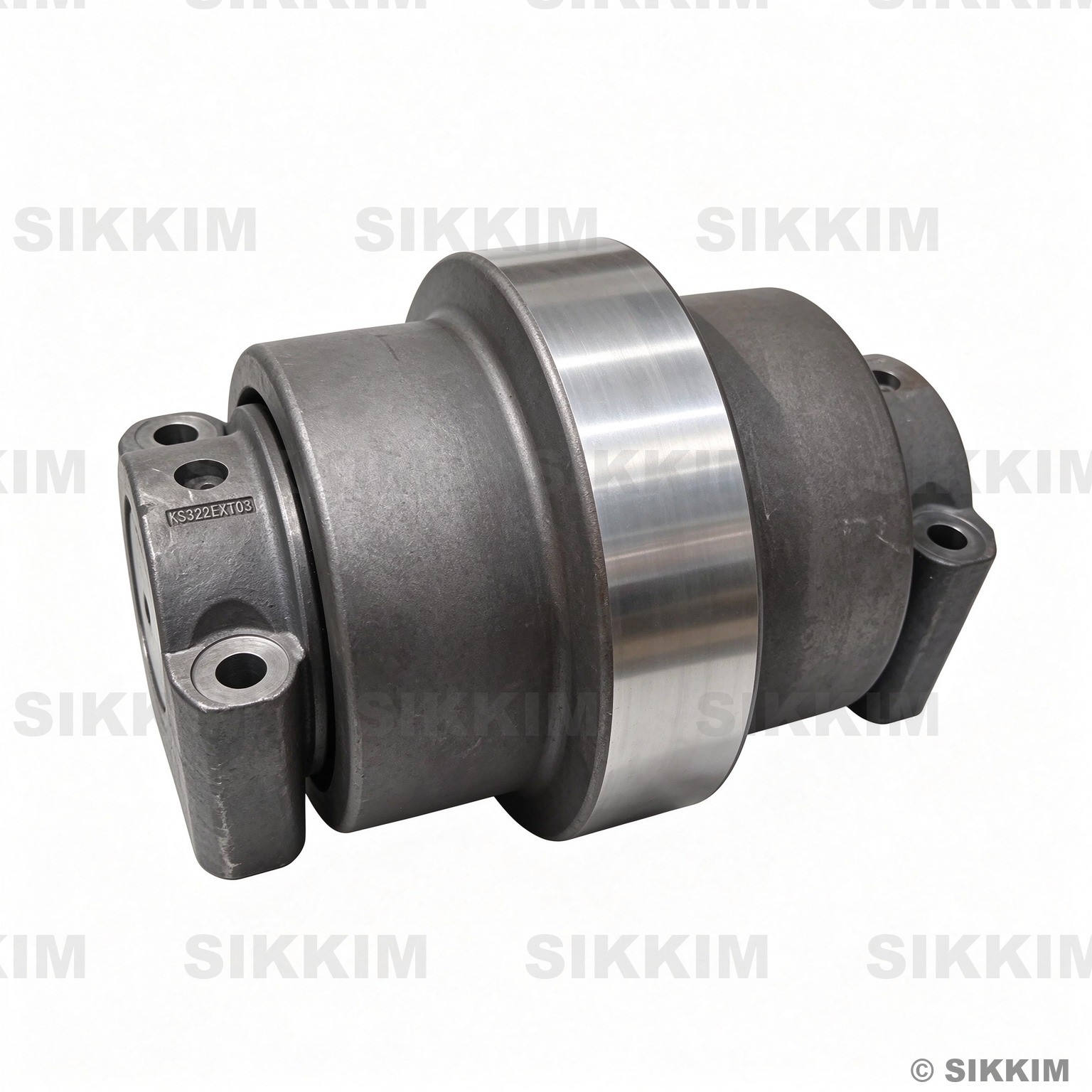
The bright metallic ring on the body is the chucking and locating datum face for the vertical lathe operation — its flatness and roundness directly determine whether the bore and floating-seal face can be finished in a single setup. Together with the bolt holes, mounting-lug locating surfaces and the traceable part stamp on the housing, it forms SIKKIM's first impression: buildable, inspectable and traceable.
2. Material: Selection Logic for a Large-Tonnage Body
A single roller carries tonnes of load, meaning the body must be highly wear-resistant yet must not crack under impact. SIKKIM specifies high-strength alloy quenched-and-tempered steel (exact grade kept confidential per OEM technical agreement):
· Alloy system: a multi-element blend raises hardenability, temper stability and core toughness, giving the body ample impact and fatigue reserve under heavy loads;
· Solid forging: the body is formed from a forged blank by rough and finish turning. The continuous metal flow along the contour avoids the internal defects common to castings;
· Incoming verification: every blank batch arrives with a mill certificate; critical furnace numbers are re-checked by spectrometer and hardness sampling, blocking substitution at the source.
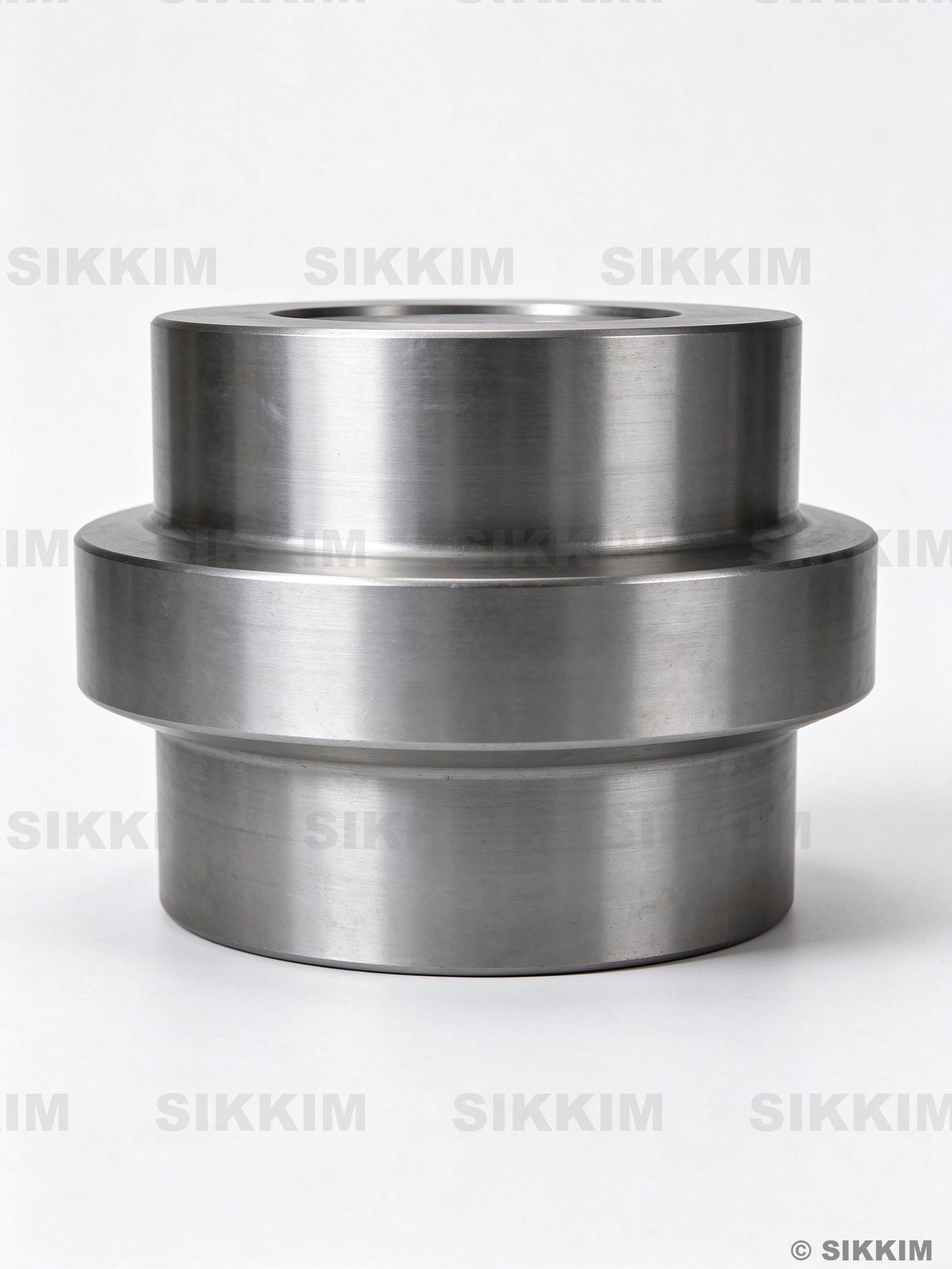
Material sets the ceiling. What truly decides service life is the heat treatment.
3. Heat Treatment: Cut the Roller Open and Let Hardness Speak
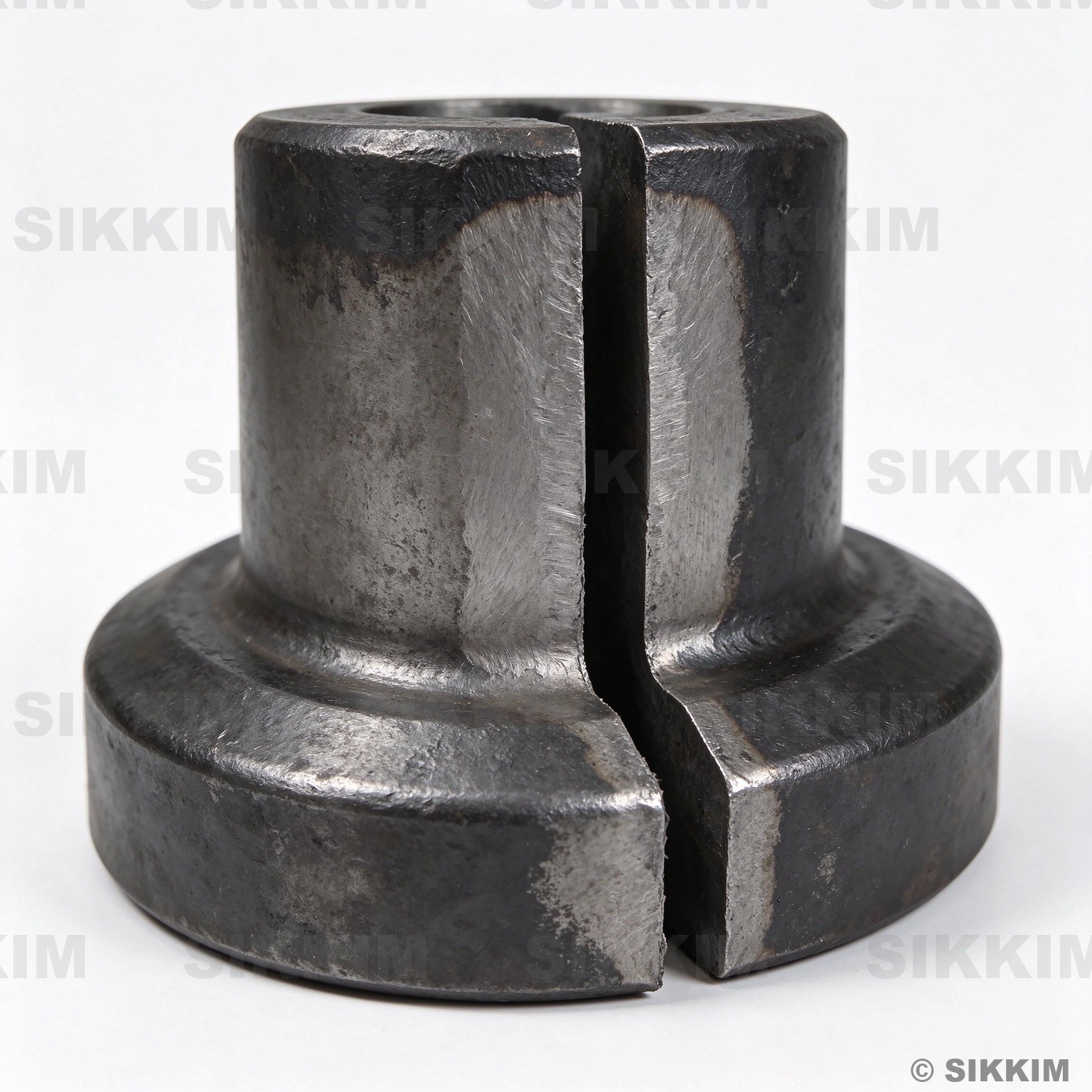
Many competitors claim deep case hardening but won't cut a roller open for you to see. SIKKIM cuts, sections and measures point by point — letting the data speak.
The R9600 roller uses medium-frequency induction quenching plus self-tempering. Section-sampled measurements from this batch of half-bodies:
Test Item | Specification | Measured Result |
Surface Hardness | HRC 48–52 | HRC 49–52 |
Case Depth | HRC ≥ 40 at 30 mm below surface | Point A @30 mm = HRC 42.6; Point C @30 mm = HRC 46.6 |
Point B continuous hardness | — | 5–45 mm depth, all ≥ HRC 47.3 |
What this hardness curve means: a wear-resistant tread with a core that is not brittle. Surface hardness sits around HRC 50 to deliver wear life, while at 30 mm depth it still holds above HRC 40 — so even after several millimetres of tread wear, the remaining hardened case is still in service.
Behind the process is work SIKKIM did itself:
· Profiled induction coils: coils customised to the R9600 tread arc so the heated layer follows the contour with no soft bands;
· Self-tempering and temper-curve matching: repeated tuning of self-tempering temperature and subsequent schedules balances surface hardness against core toughness, suppressing grinding cracks and in-service spalling;
· Periodic sectioning: beyond batch reports, the company regularly cuts rollers open and measures the hardness gradient at multiple points to confirm process stability.
4. Sealing: German GÖTZE Imported Floating Seal
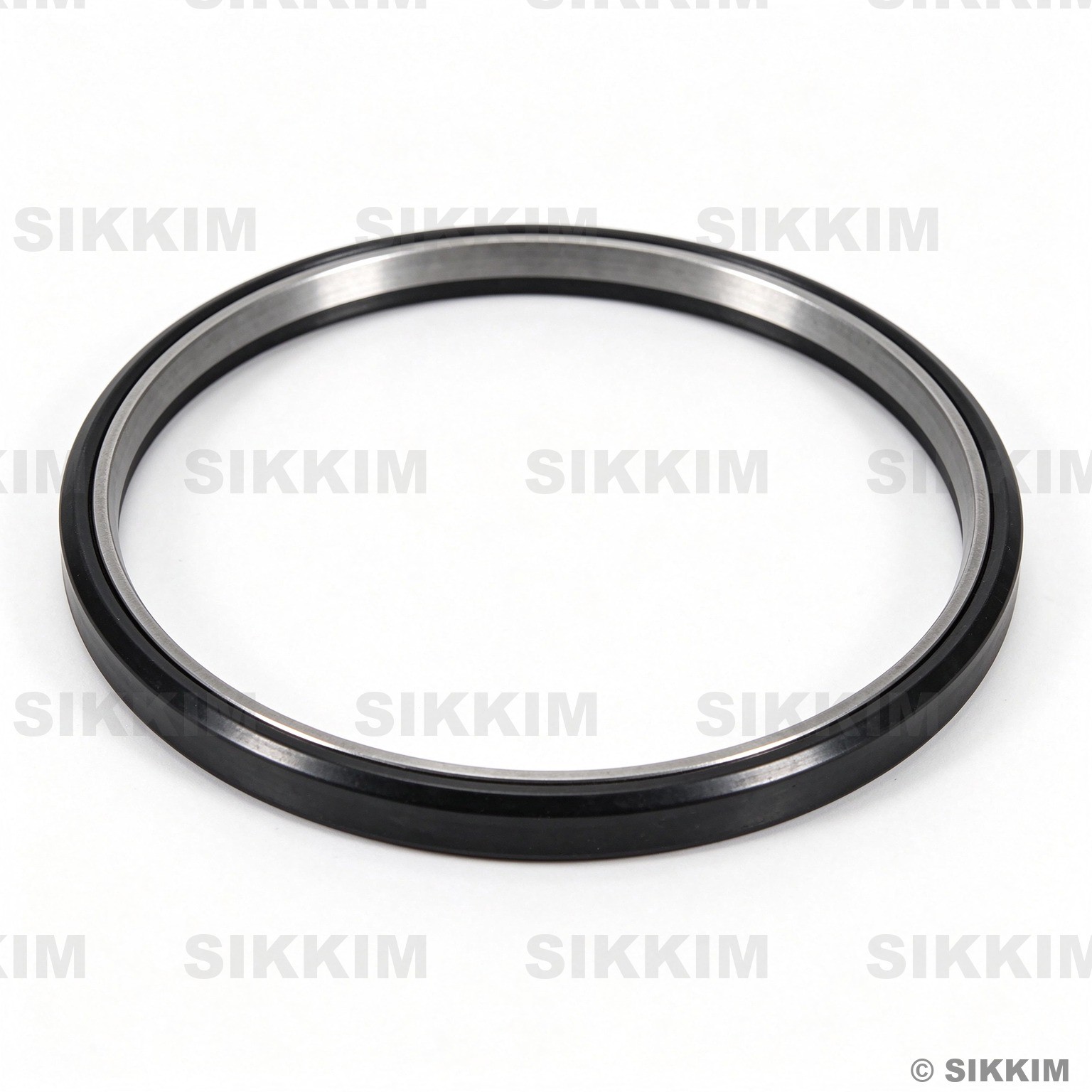
However hard the body, a single leaking seal lets mud into the bearing cavity and seizes the roller within hours. The R9600 roller uses a genuine German GÖTZE (a TENNECO brand) imported metal-face floating seal:
· Mating ring pair: two precision-lapped alloy rings press together under O-ring elasticity and rotate in contact, holding stable face pressure and resisting mud, water and slurry flushing;
· Original parts: every seal is genuine TENNECO/GÖTZE factory output — no refurbishing, no substitutes;
· Lifetime economics: a body worn by a few millimetres can keep working, but a failed seal can scrap the entire roller. Using imported original seals is the best-value calculation SIKKIM has made.
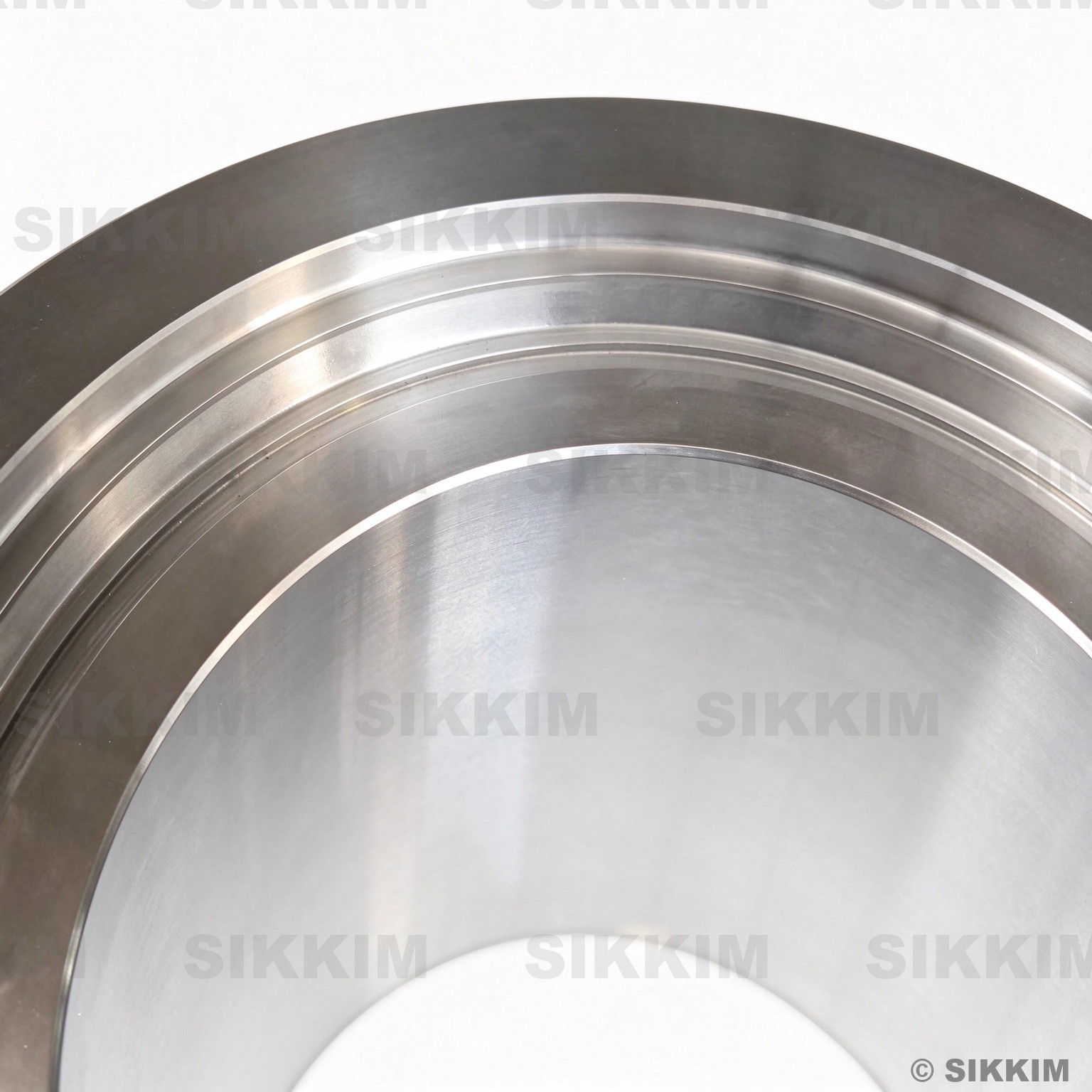
5. Machining: A Taiwan-Built Vertical Lathe, One Setup for Concentricity
Every turned surface on the roller body is finished on a Taiwan-built CNC vertical lathe worth over RMB 2 million. Its value is not a shiny finish — it's in the single setup:
· Single-setup finish: bore, floating-seal face and outer datum are turned in the same clamping, eliminating accumulated error from repeated setups at the process level and guaranteeing bore-to-seal-face concentricity;
· Interlocked datums: located on the lathe chucking datum, the seal face and seal groove are turned in a single pass, keeping groove base, groove lip and seal face concentric and preventing seal eccentricity after installation;
· Surface quality: mirror-bright edges and fine feed marks ensure uniform O-ring compression and prevent sharp edges from cutting the rubber;
· Machine rigidity: a large-tonnage roller blank weighs hundreds of kilograms; the spindle rigidity and bed damping of a large-stroke vertical lathe are the foundation of machining consistency.
6. Why SIKKIM
· Nearly a decade of large-tonnage experience: accumulated step by step from the 100-tonne to the 200-tonne class, each proven in customers' working conditions — no rushing, no skipping classes;
· In-house R&D loop: material qualification, induction-quenching tooling and floating-seal cavity design are all done in-house. The R9600 roller is the latest result of these capabilities;
· Data speaks: every batch ships with a heat-treatment inspection report — hardness, case depth and test locations are all traceable;
· No compromise on imported parts: German GÖTZE floating seals and critical bearings are sourced through top-tier domestic channels;
· Debut approaching: the R9600 roller makes its first public appearance at bauma CHINA 2026 in Shanghai — come see the hardware and talk process with us.
Taicang Sikkim Machinery Technology Co., Ltd. (SIKKIM UNDERCARRIAGE PARTS)
Specialized in excavator undercarriage: track rollers, idlers, carrier rollers and link assemblies. Supplying high-life OEM and replacement solutions for Liebherr, Caterpillar, Komatsu and other large mining equipment.

